Good knives depend not only on the grind, but above all on precise heat treatment.
The decisive factors are controlled holding times as well as careful quenching and precise temperature control, which produce a
suitable microstructure in the steel.
In our hardening shop, over 1,000 knife blades are hardened every year for customers from
Austria, Germany, and all across the EU.
In our hardening service, it is not only about achieving a specific HRC value, but also about achieving a microstructure that is as fine as possible with minimal retained austenite. Depending on the steel, blade thickness and application, we design the heat treatment so that sharpenability, edge retention and toughness are in balance.
To this end, we work with clearly defined parameters for austenitizing, quenching, tempering and cryogenic treatment. We have developed these over decades through practical work and test series. Temperatures, holding times and quenching routes are coordinated for the knife steels used and typical blade geometries.
We can measure the Rockwell hardness with a modern hardness tester from Mitutoyo, in which test force and measurement sequence are electronically controlled and the hardness is read out digitally. On selected samples, we have additionally examined the parameters metallographically in our own small laboratory in order to assess microstructure, carbide size, carbide distribution and visible inhomogeneities and to tune the parameters specifically to knife steels and typical blade geometries.
In the hardening service, we see a broad spectrum of knife steels. One focus is on stainless, high-alloy and powder-metallurgical knife steels that require demanding heat treatment. In addition, we regularly harden unalloyed carbon steels, laminated blades and Damascus blades.
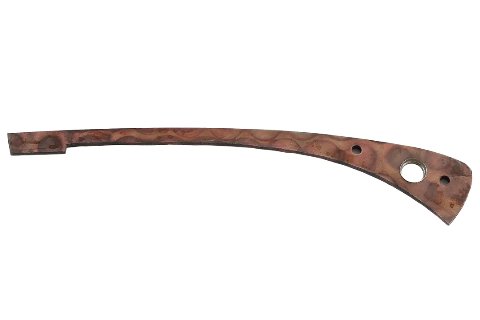
We also harden components for folding knives, such as back springs. Particularly suitable here is 1.4034, which has proven itself as a corrosion-resistant steel with a sensible combination of hardness and spring properties.
The heat treatment of knife blades is always an interaction of steel, geometry and preparation. Even with optimized parameters, distortion or individual failures can occur which cannot be completely ruled out from a technical point of view. Our straightening service can significantly improve warped blades in many cases, but extremely or unfavourably bent blades cannot always be fully straightened without increasing the risk of breakage too much.
Depending on the steel and blade geometry, various hardening and quenching routes are available.
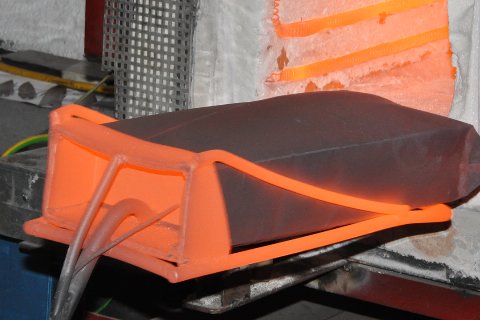
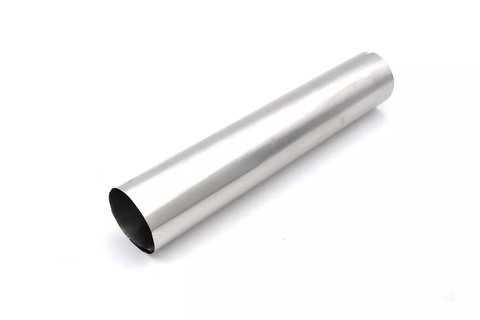
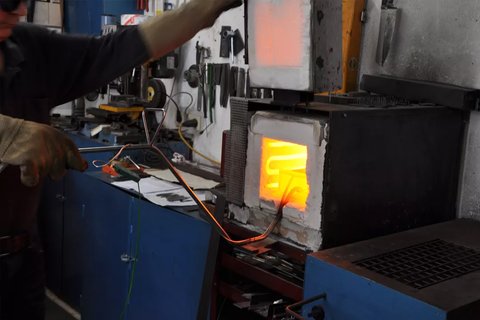
For stainless and air-hardening steels, we use a protective-gas hardening system
with argon as oxidation protection to minimize decarburization and scale. Foil packs are used for very
long blades (over 50 cm) that no longer fit in this system.
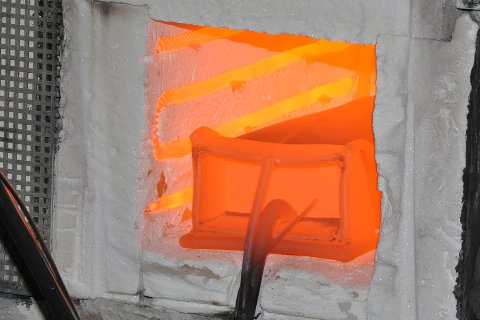
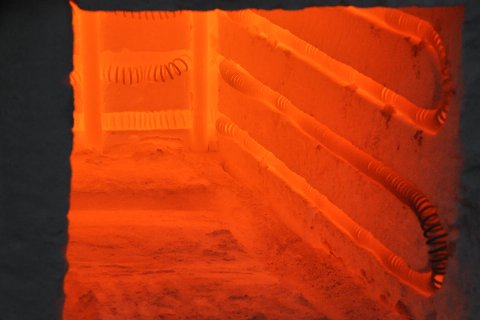
Unalloyed and low-alloy carbon steels are hardened in a conventional furnace atmosphere.
The largely closed furnace chamber ensures a relatively low oxygen content, which is generally sufficient
for these steels.
Depending on the steel and requirements, the quenching media used include a directed air flow, high-performance hardening oils such as DURIXOL V35, as well as a lower-distortion, medium-speed oil. For stainless and highly alloyed, particularly powder-metallurgical knife steels we prefer air quenching. For these steels it enables the desired Rockwell hardness with low distortion and delivers consistently reproducible results. We mainly use hardening oils for steels with higher quenching demand when stronger cooling is necessary. We fundamentally do not harden in water.
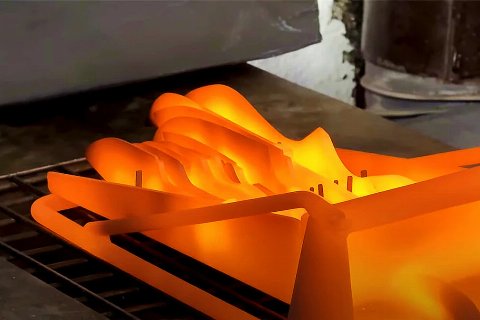
For hardening, the blades are placed in the furnace vertically with a defined spacing between them. For stainless and highly alloyed knife steels, the final air quench with a directed air flow from below ensures that both sides are evenly exposed to the airflow. This leads to very uniform cooling and contributes to low-distortion results.
For carbon steels or oil-hardening steels, the blade is immersed directly into a suitable hardening oil bath to achieve the required cooling rate.
For every heat-treatment batch, we carry out in-process hardness control and check the Rockwell hardness on a random-sample basis for each batch. This allows us to ensure that the target hardness and reproducibility of our parameters are maintained.
Anyone who additionally wants to know the HRC value of their own blade can optionally book an individual hardness test. In this case we measure exactly this blade, and the measured HRC value is marked directly on the blade with a marker.
For written documentation, we also offer a hardness certificate. In this case, that exact blade is measured separately and the proof of hardening is issued in the customer’s name.
Measurement is usually taken at the tang of the blade. As a rule, we use two to three measuring points
to reliably capture the hardness in the tang area. For stainless and highly alloyed knife steels
we achieve a largely uniform hardening, and the hardness measured there is
generally representative of the entire blade.
For oil-quenched blade steel, particularly with shorter or very slender handle sections, gripping the handle end with tongs
during immersion in the oil can lead to the edge being hardened slightly higher
than the tang. The value measured at the tang is therefore a rather conservative lower limit for the hardness
of the blade.
In industrial heat treatment, cryogenic treatment is not always performed directly after quenching, but in some cases only after an initial tempering step in order to reduce the risk of cracking. This reduces the effect on retained austenite, which is why liquid nitrogen is then used to still achieve a noticeable effect.
We cool knife blades in a powerful industrial freezer to around -85°C and apply this step directly after quenching. Depending on the steel and blade thickness, the duration of the cryogenic phase is chosen so that the transformation of retained austenite to martensite can proceed as completely as possible. In this way, the retained austenite content is significantly reduced and the foundation is laid for a stable microstructure, which is reflected in good sharpenability, high edge retention and reliable edge stability.
Cooling takes place via air in the freezer and not via liquid media. This avoids severe thermal shocks and keeps the temperature change for the blades as gentle as possible. For rusting core-layer steels made from carbon steel, we generally do not use cryogenic treatment. Because of the different materials in the core and outer layers, strong cooling can create stresses that may cause the hard core layer to crack in the middle.
You can find detailed information on procedure, preparation and shipping on our website for the knife hardening service.